
State Requirement Info
 Presented by Angela Shoup, PhD, Maggie Kettler, AuD, Megan Pesch, MD
 Presented by Kristen Janky, PhD, CCC-A
 Presented by Amanda Picioli, MED, AuD, CCC-A, Jewel Morris, MS, CCC-SLP
Presented by Andrea Castellucci, MD
Presented by Richard E. Gans, PhD, CCC-A, DFAA
Presented by Tricia Stanley, AuD, Daniel Romero, AuD, PhD
 Presented by Evan L. Claytor, AuD, CCC-A
Presented by Margaret Kenna, MD, MPH, Shelby Redfield, MS CGC
Presented by Carly Alicea, AuD, PhD, CCC-A
 Presented by Joan Hewitt, AuD
222 courses found
1
https://www.audiologyonline.com/audiology-ceus/course/to-start-ccmv-screening-program-41706
How to Start a cCMV Screening Program, in partnership with the American Academy of Audiology
This course provides an overview of congenital cytomegalovirus (cCMV) as a leading cause of pediatric sensorineural hearing loss and outlines the rationale for newborn cCMV screening. Practical, step-by-step strategies for planning, implementing, and sustaining cCMV screening programs across a variety of clinical and hospital settings is presented.
auditory, textual, visual
129
USD
Subscription
Unlimited COURSE Access for $129/year
OnlineOnly
AudiologyOnline
www.audiologyonline.com
How to Start a cCMV Screening Program, in partnership with the American Academy of Audiology
This course provides an overview of congenital cytomegalovirus (cCMV) as a leading cause of pediatric sensorineural hearing loss and outlines the rationale for newborn cCMV screening. Practical, step-by-step strategies for planning, implementing, and sustaining cCMV screening programs across a variety of clinical and hospital settings is presented.
41706
Online
PT60M
How to Start a cCMV Screening Program, in partnership with the American Academy of Audiology
Course: #41706Level: Intermediate1 Hour
AAA/0.1 Intermediate; ACAud inc HAASA/1.0; ASHA/0.1 Intermediate, Professional; BAA/1.0; CAA/1.0; Calif. SLPAB/1.0; IACET/0.1; IHS/1.0; Kansas, LTS-S0035/1.0; NZAS/1.0; SAC/1.0; TX TDLR, #142/1.0 Non-manufacturer; Tier 1 (ABA Certificants)/0.1
This course provides an overview of congenital cytomegalovirus (cCMV) as a leading cause of pediatric sensorineural hearing loss and outlines the rationale for newborn cCMV screening. Practical, step-by-step strategies for planning, implementing, and sustaining cCMV screening programs across a variety of clinical and hospital settings is presented.
2
https://www.audiologyonline.com/audiology-ceus/course/remote-camera-vhit-what-it-41771
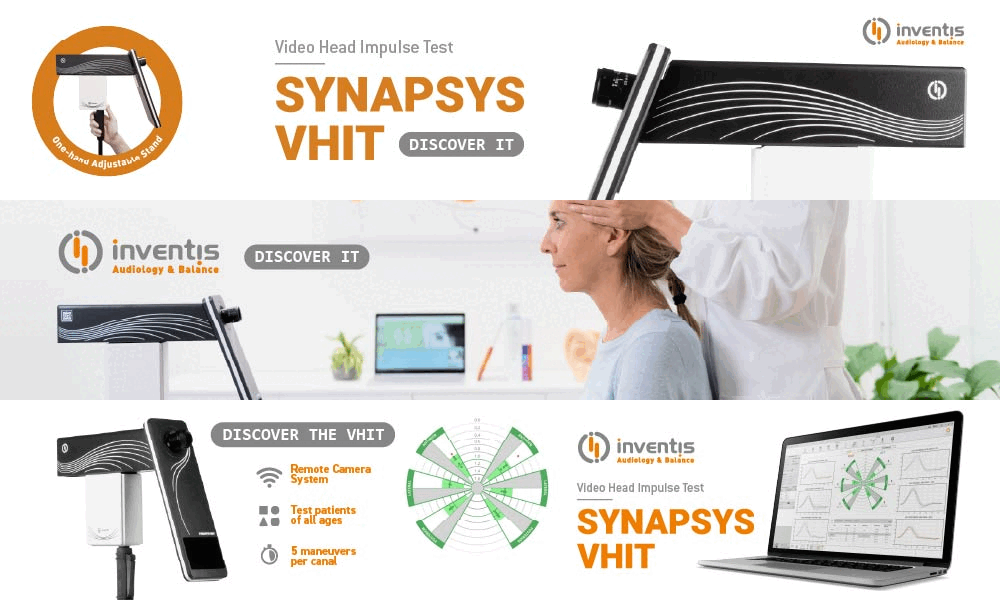
Remote Camera vHIT: What Is It and How Does It Fit Into My Pediatric Vestibular Test Battery?
Children with hearing loss are at increased risk for vestibular loss. Several important effects of vestibular loss can be improved if identified and treated. As such, there is growing emphasis on identifying vestibular loss in infants and young children. The remote camera video head impulse test (vHIT) is a new tool used to assess vestibular function in young children. The purpose of this presentation is to review remote camera vHIT and where it fits in pediatric vestibular assessment protocols. In this presentation, the effects of vestibular loss in children, the importance of pediatric vestibular assessment, and administration and interpretation of remote camera vHIT will be reviewed. Case studies will be used to highlight how remote camera vHIT can be implemented in pediatric vestibular assessment.
auditory, textual, visual
129
USD
Subscription
Unlimited COURSE Access for $129/year
OnlineOnly
AudiologyOnline
www.audiologyonline.com
Remote Camera vHIT: What Is It and How Does It Fit Into My Pediatric Vestibular Test Battery?
Children with hearing loss are at increased risk for vestibular loss. Several important effects of vestibular loss can be improved if identified and treated. As such, there is growing emphasis on identifying vestibular loss in infants and young children. The remote camera video head impulse test (vHIT) is a new tool used to assess vestibular function in young children. The purpose of this presentation is to review remote camera vHIT and where it fits in pediatric vestibular assessment protocols. In this presentation, the effects of vestibular loss in children, the importance of pediatric vestibular assessment, and administration and interpretation of remote camera vHIT will be reviewed. Case studies will be used to highlight how remote camera vHIT can be implemented in pediatric vestibular assessment.
41771
Online
PT60M
Remote Camera vHIT: What Is It and How Does It Fit Into My Pediatric Vestibular Test Battery?
Course: #41771Level: Intermediate1 Hour
AAA/0.1 Intermediate; ACAud inc HAASA/1.0; AHIP/1.0; BAA/1.0; CAA/1.0; Calif. SLPAB/1.0; IACET/0.1; IHS/1.0; Kansas, LTS-S0035/1.0; NZAS/1.0; SAC/1.0; TX TDLR, #142/1.0 Manufacturer
Children with hearing loss are at increased risk for vestibular loss. Several important effects of vestibular loss can be improved if identified and treated. As such, there is growing emphasis on identifying vestibular loss in infants and young children. The remote camera video head impulse test (vHIT) is a new tool used to assess vestibular function in young children. The purpose of this presentation is to review remote camera vHIT and where it fits in pediatric vestibular assessment protocols. In this presentation, the effects of vestibular loss in children, the importance of pediatric vestibular assessment, and administration and interpretation of remote camera vHIT will be reviewed. Case studies will be used to highlight how remote camera vHIT can be implemented in pediatric vestibular assessment.
3
https://www.audiologyonline.com/audiology-ceus/course/navigating-college-careers-effective-transition-42981
Navigating College and Careers: Effective Transition Planning for Deaf and Hard-of-Hearing High School Students, in partnership with RIT/National Technical Institute for the Deaf
The course offers essential guidance for navigating life after high school for Deaf and Hard of Hearing students. It addresses how to prepare students for the transition from a structured support system of high school to more independent adulthood experiences, such as postsecondary education, employment, and/or independent living.
auditory, textual, visual
129
USD
Subscription
Unlimited COURSE Access for $129/year
OnlineOnly
AudiologyOnline
www.audiologyonline.com
Navigating College and Careers: Effective Transition Planning for Deaf and Hard-of-Hearing High School Students, in partnership with RIT/National Technical Institute for the Deaf
The course offers essential guidance for navigating life after high school for Deaf and Hard of Hearing students. It addresses how to prepare students for the transition from a structured support system of high school to more independent adulthood experiences, such as postsecondary education, employment, and/or independent living.
42981
Online
PT60M
Navigating College and Careers: Effective Transition Planning for Deaf and Hard-of-Hearing High School Students, in partnership with RIT/National Technical Institute for the Deaf
Course: #42981Level: Intermediate1 Hour
AAA/0.1 Intermediate; ACAud inc HAASA/1.0; AHIP/1.0; ASHA/0.1 Intermediate, Professional; BAA/1.0; CAA/1.0; Calif. SLPAB/1.0; IACET/0.1; IHS/1.0; Kansas, LTS-S0035/1.0; NZAS/1.0; SAC/1.0; TX TDLR, #142/1.0 Non-manufacturer
Under Review: AG Bell - LSLS/1.0 Domain 8
Under Review: AG Bell - LSLS/1.0 Domain 8
The course offers essential guidance for navigating life after high school for Deaf and Hard of Hearing students. It addresses how to prepare students for the transition from a structured support system of high school to more independent adulthood experiences, such as postsecondary education, employment, and/or independent living.
4
https://www.audiologyonline.com/audiology-ceus/course/bascule-maneuver-for-management-atypical-41670
Bascule Maneuver for the Management of Atypical Posterior Canal BPPV
While typical posterior canal-BPPV is successfully managed with standard repositionings in the vast majority of cases, atypical variants, where otoconia settle in uncommon/stenotic canal tracts generating unusual positional nystagmus, are usually refractory and their management is still debated. They include posterior canal - cupulolithiasis, apogeotropic posterior canal - BPPV, sitting - up vertigo and posterior canalith jam. In these conditions, impulsive maneuvers are usually needed. While Brandt-Daroff exercises aim to disperse debris using random rotations, we designed a tailored impulsive maneuver along the affected canal plane (the bascule maneuver), aiming to treat these variants or to convert them in typical forms, thus allowing to localize otoconia in uncertain cases. Here we present this novel physical therapy and discuss the results of our preliminary study on the Bascule maneuver, with a series of videos and clinical cases drawn from personal experience.
auditory, textual, visual
129
USD
Subscription
Unlimited COURSE Access for $129/year
OnlineOnly
AudiologyOnline
www.audiologyonline.com
Bascule Maneuver for the Management of Atypical Posterior Canal BPPV
While typical posterior canal-BPPV is successfully managed with standard repositionings in the vast majority of cases, atypical variants, where otoconia settle in uncommon/stenotic canal tracts generating unusual positional nystagmus, are usually refractory and their management is still debated. They include posterior canal - cupulolithiasis, apogeotropic posterior canal - BPPV, sitting - up vertigo and posterior canalith jam. In these conditions, impulsive maneuvers are usually needed. While Brandt-Daroff exercises aim to disperse debris using random rotations, we designed a tailored impulsive maneuver along the affected canal plane (the bascule maneuver), aiming to treat these variants or to convert them in typical forms, thus allowing to localize otoconia in uncertain cases. Here we present this novel physical therapy and discuss the results of our preliminary study on the Bascule maneuver, with a series of videos and clinical cases drawn from personal experience.
41670
Online
PT150M
Bascule Maneuver for the Management of Atypical Posterior Canal BPPV
Course: #41670Level: Advanced2.5 Hours
AAA/0.25 Advanced; ACAud inc HAASA/2.5; AHIP/2.5; BAA/2.5; CAA/2.5; Calif. SLPAB/2.5; IACET/0.3; IHS/2.5; Kansas, LTS-S0035/2.5; NZAS/3.0; SAC/2.5; TX TDLR, #142/3.0 Manufacturer
While typical posterior canal-BPPV is successfully managed with standard repositionings in the vast majority of cases, atypical variants, where otoconia settle in uncommon/stenotic canal tracts generating unusual positional nystagmus, are usually refractory and their management is still debated. They include posterior canal - cupulolithiasis, apogeotropic posterior canal - BPPV, sitting - up vertigo and posterior canalith jam. In these conditions, impulsive maneuvers are usually needed. While Brandt-Daroff exercises aim to disperse debris using random rotations, we designed a tailored impulsive maneuver along the affected canal plane (the bascule maneuver), aiming to treat these variants or to convert them in typical forms, thus allowing to localize otoconia in uncertain cases. Here we present this novel physical therapy and discuss the results of our preliminary study on the Bascule maneuver, with a series of videos and clinical cases drawn from personal experience.
5
https://www.audiologyonline.com/audiology-ceus/course/pediatric-balance-assessment-41492
Pediatric Balance Assessment: It's as Simple as A-B-C, in partnership with the American Academy of Audiology
This course provides attendees with an overview of the development of balance function, conditions and assessment protocols necessary for comprehensive vestibular-balance assessment of infants to adolescents. Video case studies of neonates to teenagers are highlighted to enhance the content.
auditory, textual, visual
129
USD
Subscription
Unlimited COURSE Access for $129/year
OnlineOnly
AudiologyOnline
www.audiologyonline.com
Pediatric Balance Assessment: It's as Simple as A-B-C, in partnership with the American Academy of Audiology
This course provides attendees with an overview of the development of balance function, conditions and assessment protocols necessary for comprehensive vestibular-balance assessment of infants to adolescents. Video case studies of neonates to teenagers are highlighted to enhance the content.
41492
Online
PT60M
Pediatric Balance Assessment: It's as Simple as A-B-C, in partnership with the American Academy of Audiology
Course: #41492Level: Intermediate1 Hour
AAA/0.1 Intermediate; ACAud inc HAASA/1.0; AHIP/1.0; ASHA/0.1 Intermediate, Professional; BAA/1.0; CAA/1.0; Calif. SLPAB/1.0; IACET/0.1; IHS/1.0; Kansas, LTS-S0035/1.0; NZAS/1.0; SAC/1.0; TX TDLR, #142/1.0 Non-manufacturer; Tier 1 (ABA Certificants)/0.1
This course provides attendees with an overview of the development of balance function, conditions and assessment protocols necessary for comprehensive vestibular-balance assessment of infants to adolescents. Video case studies of neonates to teenagers are highlighted to enhance the content.
6
https://www.audiologyonline.com/audiology-ceus/course/using-eeg-biomarkers-to-understand-40915
The Use of EEG Biomarkers to Understand Cortical-Vestibular Interactions, in partnership with Vanderbilt University
This course examines the emerging evidence utilizing EEG biomarkers to gain a further understanding of cortical-vestibular interactions. Emphasis will be placed on understanding the history of EEG, clinical manifestations of cortical-vestibular dysfunction, and how EEG rhythms are currently being used in research to gain a better understanding of the vestibular system.
auditory, textual, visual
129
USD
Subscription
Unlimited COURSE Access for $129/year
OnlineOnly
AudiologyOnline
www.audiologyonline.com
The Use of EEG Biomarkers to Understand Cortical-Vestibular Interactions, in partnership with Vanderbilt University
This course examines the emerging evidence utilizing EEG biomarkers to gain a further understanding of cortical-vestibular interactions. Emphasis will be placed on understanding the history of EEG, clinical manifestations of cortical-vestibular dysfunction, and how EEG rhythms are currently being used in research to gain a better understanding of the vestibular system.
40915
Online
PT60M
The Use of EEG Biomarkers to Understand Cortical-Vestibular Interactions, in partnership with Vanderbilt University
Course: #40915Level: Intermediate1 Hour
AAA/0.1 Intermediate; ACAud inc HAASA/1.0; AHIP/1.0; ASHA/0.1 Intermediate, Professional; BAA/1.0; CAA/1.0; Calif. SLPAB/1.0; IACET/0.1; IHS/1.0; Kansas, LTS-S0035/1.0; NZAS/1.0; SAC/1.0; TX TDLR, #142/1.0 Non-manufacturer
This course examines the emerging evidence utilizing EEG biomarkers to gain a further understanding of cortical-vestibular interactions. Emphasis will be placed on understanding the history of EEG, clinical manifestations of cortical-vestibular dysfunction, and how EEG rhythms are currently being used in research to gain a better understanding of the vestibular system.
7
https://www.audiologyonline.com/audiology-ceus/course/unlock-world-new-possibilities-for-41440
Unlock a World of New Possibilities for Tweens and Teens
Learn how the latest Infinio Ultra innovations unlock a world of new possibilities for teens and tweens. Discussion on applications of next-level AI developments specific for the pediatric patient and updates to myPhonak Junior will be reviewed.
auditory, textual, visual
129
USD
Subscription
Unlimited COURSE Access for $129/year
OnlineOnly
AudiologyOnline
www.audiologyonline.com
Unlock a World of New Possibilities for Tweens and Teens
Learn how the latest Infinio Ultra innovations unlock a world of new possibilities for teens and tweens. Discussion on applications of next-level AI developments specific for the pediatric patient and updates to myPhonak Junior will be reviewed.
41440
Online
PT60M
Unlock a World of New Possibilities for Tweens and Teens
Course: #41440Level: Intermediate1 Hour
AAA/0.1 Intermediate; ACAud inc HAASA/1.0; AG Bell - LSLS/1.0 Domain 1; AHIP/1.0; BAA/1.0; CAA/1.0; Calif. SLPAB/1.0; IACET/0.1; IHS/1.0; Kansas, LTS-S0035/1.0; NZAS/1.0; SAC/1.0; TX TDLR, #142/1.0 Manufacturer
Learn how the latest Infinio Ultra innovations unlock a world of new possibilities for teens and tweens. Discussion on applications of next-level AI developments specific for the pediatric patient and updates to myPhonak Junior will be reviewed.
8
https://www.audiologyonline.com/audiology-ceus/course/genetics-pediatric-hearing-loss-in-40905
Genetics of Pediatric Hearing Loss in the Age of Precision Medicine, in partnership with the American Academy of Audiology
Most pediatric sensorineural hearing loss has a genetic etiology, and understanding that etiology has important implications for patients. This course will cover standard practices in the field of clinical genetics for hearing loss, review implications of diagnosis, and discuss how audiologists can play a role in the genetic counseling experience.
auditory, textual, visual
129
USD
Subscription
Unlimited COURSE Access for $129/year
OnlineOnly
AudiologyOnline
www.audiologyonline.com
Genetics of Pediatric Hearing Loss in the Age of Precision Medicine, in partnership with the American Academy of Audiology
Most pediatric sensorineural hearing loss has a genetic etiology, and understanding that etiology has important implications for patients. This course will cover standard practices in the field of clinical genetics for hearing loss, review implications of diagnosis, and discuss how audiologists can play a role in the genetic counseling experience.
40905
Online
PT60M
Genetics of Pediatric Hearing Loss in the Age of Precision Medicine, in partnership with the American Academy of Audiology
Course: #40905Level: Intermediate1 Hour
AAA/0.1 Intermediate; ACAud inc HAASA/1.0; AHIP/1.0; ASHA/0.1 Intermediate, Professional; BAA/1.0; CAA/1.0; Calif. SLPAB/1.0; IACET/0.1; IHS/1.0; Kansas, LTS-S0035/1.0; NZAS/1.0; SAC/1.0; TX TDLR, #142/1.0 Non-manufacturer; Tier 1 (ABA Certificants)/0.1
Most pediatric sensorineural hearing loss has a genetic etiology, and understanding that etiology has important implications for patients. This course will cover standard practices in the field of clinical genetics for hearing loss, review implications of diagnosis, and discuss how audiologists can play a role in the genetic counseling experience.
9
https://www.audiologyonline.com/audiology-ceus/course/classroom-acoustics-and-listening-technology-42969
Classroom Acoustics and Classroom Listening Technology, in partnership with RIT/National Technical Institute for the Deaf
This course equips audiologists and speech-language pathologists to evaluate classroom acoustics and their impact on Deaf and Hard of Hearing (DHH) students. The course provides discussion on assistive listening technologies and applies practical strategies to support appropriate accommodations and improved student outcomes.
auditory, textual, visual
129
USD
Subscription
Unlimited COURSE Access for $129/year
OnlineOnly
AudiologyOnline
www.audiologyonline.com
Classroom Acoustics and Classroom Listening Technology, in partnership with RIT/National Technical Institute for the Deaf
This course equips audiologists and speech-language pathologists to evaluate classroom acoustics and their impact on Deaf and Hard of Hearing (DHH) students. The course provides discussion on assistive listening technologies and applies practical strategies to support appropriate accommodations and improved student outcomes.
42969
Online
PT60M
Classroom Acoustics and Classroom Listening Technology, in partnership with RIT/National Technical Institute for the Deaf
Course: #42969Level: Intermediate1 Hour
AAA/0.1 Intermediate; ACAud inc HAASA/1.0; AG Bell - LSLS/1.0 Domain 1; AHIP/1.0; ASHA/0.1 Intermediate, Professional; BAA/1.0; CAA/1.0; Calif. SLPAB/1.0; IACET/0.1; IHS/1.0; Kansas, LTS-S0035/1.0; NZAS/1.0; SAC/1.0; TX TDLR, #142/1.0 Non-manufacturer
This course equips audiologists and speech-language pathologists to evaluate classroom acoustics and their impact on Deaf and Hard of Hearing (DHH) students. The course provides discussion on assistive listening technologies and applies practical strategies to support appropriate accommodations and improved student outcomes.
10
https://www.audiologyonline.com/audiology-ceus/course/genetic-testing-and-counseling-as-41327
Genetic Testing and Counseling as Part of the Audiologic Assessment
Despite more than 60% of congenital sensorineural hearing loss being due to an underlying genetic cause, and multiple medical societies recommending a comprehensive gene panel as part of the diagnostic workup, only a minority of eligible patients obtain genetic testing. Audiologists are in a privileged position to be frontline healthcare providers in the diagnosis and management of individuals with genetic forms of hearing loss. The audiologist’s role related to genetic testing and counseling and how the Resonate® sponsored genetic testing and counseling program can be utilized to help facilitate an earlier and more accurate diagnosis will be discussed.
auditory, textual, visual
129
USD
Subscription
Unlimited COURSE Access for $129/year
OnlineOnly
AudiologyOnline
www.audiologyonline.com
Genetic Testing and Counseling as Part of the Audiologic Assessment
Despite more than 60% of congenital sensorineural hearing loss being due to an underlying genetic cause, and multiple medical societies recommending a comprehensive gene panel as part of the diagnostic workup, only a minority of eligible patients obtain genetic testing. Audiologists are in a privileged position to be frontline healthcare providers in the diagnosis and management of individuals with genetic forms of hearing loss. The audiologist’s role related to genetic testing and counseling and how the Resonate® sponsored genetic testing and counseling program can be utilized to help facilitate an earlier and more accurate diagnosis will be discussed.
41327
Online
PT30M
Genetic Testing and Counseling as Part of the Audiologic Assessment
Course: #41327Level: Introductory0.5 Hours
No CEUs/Hours Offered
Despite more than 60% of congenital sensorineural hearing loss being due to an underlying genetic cause, and multiple medical societies recommending a comprehensive gene panel as part of the diagnostic workup, only a minority of eligible patients obtain genetic testing. Audiologists are in a privileged position to be frontline healthcare providers in the diagnosis and management of individuals with genetic forms of hearing loss. The audiologist’s role related to genetic testing and counseling and how the Resonate® sponsored genetic testing and counseling program can be utilized to help facilitate an earlier and more accurate diagnosis will be discussed.